
 学校主页
学校主页 院长信箱
院长信箱01 Background
Soil salinization has become one of the most important and widely affected land degradation problems in arid, semi-arid and coastal areas around the world due to the huge impacts of global climate change and human activities. Salt-affected soils cover a total area of 1.381 billion hectares (ha) worldwide, making up 10.7 percent of the total land area (FAO, 2023). In addition, there are 1.038 billion ha of soil at potential risk of salinization globally. Approximately 20 percent of the world’s cultivated land and 33 percent of its irrigated areas are currently affected by salinization, a problem that is intensifying annually by 10 percent in many regions, with projections indicating that over 50 percent of global cultivated land could be impacted by 2050.
China has large and diversified saline-alkali land distributed in the north, northeastern, northwestern and eastern coastal regions. The comprehensive utilization of saline-alkali land in China has always been of great importance and has been elevated to a national strategy due to the land–food–population trilemma. The Chinese government issued a National Action Plan on Promoting the Comprehensive Utilization of Saline-Alkali Land, and established the National Technology Innovation Center for Saline-Alkali Agriculture (NTICSA) to strengthen national collaborative innovation in three research and innovation (R&I) priorities: salt-tolerant breeding, salt-affected soil improvement and productivity enhancement, and the ecological and value-added utilization of saline-alkali land. Together, these initiatives provide scientific and technological support, as well as practical solutions, for the sustainable development of saline agriculture.
Consequently, saline-alkali land serves as a crucial reserve of arable land resources, with significant strategic value for ensuring food and nutrition security, addressing climate change, mitigating land degradation and advancing sustainable development. Therefore, the development of saline agriculture through the comprehensive utilization of saline-alkali land is essential for safeguarding livelihoods and food security at the local and global levels.
Science and technological innovation is a key driver for sustainable development in saline agriculture, with international cooperation being the primary catalyst. In order to further strengthen international cooperation on advancing the development of saline agriculture, NTICSA and the Food and Agriculture Organization of the United Nations (FAO) are joining efforts with other partners to organize the International Conference on Saline Agriculture (ICSA-2026) in October 2026 in Dongying, Shandong Province of China.
The conference seeks to be an important platform for different partners to share knowledge, experience and innovative solutions for the sustainable development of saline agriculture. It will bring together representatives from governments, public and private agencies, research, education, and extension sectors in China and around the world to engage in discussions on cutting-edge technologies, innovative practices, policies and academic collaborations for advancing the development of global saline agriculture.
02 Objectives
The objectives of the conference are as follows:
examine the latest scientific advances and innovative technologies for the comprehensive utilization of saline-alkali land;
share practices and experiences on the sustainable management and utilization of saline-alkali land;
identify key enabling factors or conditions to scale up sustainable and resilient saline agriculture;
identify priority actions towards consensus on a global initiative for sustainable and climate-resilient saline agriculture.
03 Organization
Organizers
The conference is organized by:
The NTICSA, Dongying, China.
The Land and Water Division of FAO, Rome, Italy.
Co-organizers
The conference is co-organized by:
The Center of Technology Innovation for Comprehensive Utilization of Saline-Alkali Land (CTISA), Dongying, China.
The Institute of Agricultural Resources and Regional Planning (IARRP), the Chinese Academy of Agricultural Sciences (CAAS).
The Institute of Environment and Sustainable Development in Agriculture (IEDA), CAAS.
The Center of Excellence of Saline Agriculture (CESA), CAAS.
The State Key Laboratory of Efficient Utilization of Arable Land in China (SKL-EUALC).
The State Key Laboratory of Efficient Utilization of Agricultural Water Resources (SKL-EUAWR).
Partners
The conference is partnered by:
The Global Soil Partnership – International Network of Salt-affected Soils (GSP-INSAS).
The Global Framework on Water Scarcity in Agriculture (WASAG).
The International Center for Biosaline Agriculture (ICBA).
The International Center for Agricultural Research in the Dry Areas (ICARDA).
The International Water Management Institute (IWMI).
The International Crops Research Institute for the Semi-Arid Tropics (ICRISAT).
The National Alliance of Science and Technology Innovation for Saline-Alkali Land (NASTISAL).
The National Alliance of Science and Technology Innovation for Dryland Agriculture (NASTIDA).
The Shandong Academy of Agricultural Sciences (SAAS).
The Institute of Crop Sciences (ICS), CAAS.
The Agricultural Genomics Institute at Shenzhen (AGIS), CAAS.
The Shandong Agricultural University (SDAU).
The Qingdao Agricultural University (QAU).
The Yellow River Delta Intelligent Agricultural Machinery Equipment Industry Academy (YRDIA).
The Key Laboratory of Dryland Agriculture, Ministry of Agriculture and Rural Affairs (KLDA, MARA).
Sponsors (updated regularly)
The conference is sponsored by:
The Kingenta Ecological Engineering Group Co., Ltd., Linshu, China.
The Qingdao Seawin Biotech Group Co., Ltd, Qingdao, China.
The Shandong Agricultural Group Co., Ltd, Jinan, China.
Organizing committee (updated regularly)
Co-chair: Mei Xurong (NTICSA) and Li Lifeng (FAO).
Members: Nora Berrahmouni (FAO), Jean Boroto (FAO), Thorunn Wolfram Petursdottir (FAO), Tong Yuxin (FAO), Gong Xifeng (CGIAR), Ai Chao (CAAS), Hao Weiping (CAAS), Jia Xi (SAAS), Jiang Qiyan (CAAS), Leng Changjian (SDAU), Li Xiangdong (SAAS), Li Yuyi (CAAS), Liu Luxiang (CAAS), Shang Lianguang (CAAS), Wang Dongwei (YRDIA), Wang Ren (CAAS), Yang Changjun (NTICSA), and Zhao Jinshan (QAU).
Secretariat: Yang Huijuan (AHIDAYRD), Rong Ziguo (AHIDAYRD), Zhang Hao (AHIDAYRD), Shi Xueping (AHIDAYRD), Li Haoru (CAAS), Li Shengping (CAAS), Liu Si (CAAS), and Lu Miao (CAAS).
Academic committee (updated regularly)
Co-chair: Tang Huajun (CAAS) and Jorge Batlle-Sales (INSAS).
Members: Kang Shaozhong (CAU), Cao Xiaofeng (CAS), Chong Kang (CAS), Xu Minggang (SXAU),Yu Jingquan (ZJU), Wang Lichun (JAAS), Lu Zhanyuan (IMAAAHS), George Papadakis (AUA), Fu Xiangdong (CAS), Aly Abousabaa (ICARDA), Mark Smith (IWMI), Tarifa Alzaabi (ICBA), Himanshu Pathak (ICRISAT), Vinay Nangia (ICARDA), Wu Wenbin (CAAS), Yi Keke (CAAS), Zhou Wenbin (CAAS), Wang Guirong (CAAS), and Liu Kaichang (SAAS).
04 Thematic sessions
The ICSA-2026 will feature plenary sessions, parallel sessions, a high-level panel discussion and a roundtable discussion.
Plenary sessions will be dedicated to keynote presentations by renowned international scientists in fields such as saline agriculture, dryland agriculture and water resource management.
Parallel sessions will be organized for distinguished experts in seven thematic areas to share their insights on:
1. Salt-tolerant crop breeding:
AI-based gene database for salt-tolerant plants and intelligent breeding.
Screening, identification and innovative utilization of salt-tolerant germplasm resources.
Mining of salt-tolerance key genes and innovation of molecular breeding technologies.
Breeding of high-quality, high-yield and salt-tolerant crops/forages for saline-alkali environments.
Matching technologies of improved varieties and cultivation methods for saline alkali tolerant crops and their application.
2. Precision monitoring and ecological management:
Intelligent monitoring, assessment, and early warning technologies for saline-alkali land.
Ecological management and soil quality improvement of saline-alkali land.
Ecological management and utilization models of saline-alkali land.
3. Water-saving and dryland agriculture:
Drought disaster prevention and climate-resilient rainfed agriculture.
Intelligent water management and precision irrigation in dryland agriculture.
Optimized allocation of multiple water resources and salinity control for water-saving agriculture.
Technological integrations and regional practices for rainfed and water-saving agriculture.
4. Smart facilities and mechanization:
Innovative applications of intelligent agricultural machinery and equipment for saline agriculture.
Intelligent agriculture integration and innovative applications for saline agriculture.
5. Advancing sustainable management of salt-affected soils through policy,partnerships and scaling up action (INSAS):
Policies and governance frameworks for sustainable management of salt-affected soils.
Capacity development, extension services, and international cooperation for sustainable soil management in saline environments.
Multi-stakeholder partnerships to accelerate the adoption of sustainable soil management and contribute to food security and climate resilience.
6. Nutritional, healthy and value-added processing:
Nutritional quality characteristics and processing technologies of special saline-alkali land products.
Functional exploitation and healthy food fabrication of special saline-alkali crops.
Value-added utilization and industrial application of by-products of special saline-alkali agriculture.
7. Talent and discipline development:
Elite innovative talents development for saline agriculture.
Discipline development of science and engineering for saline-alkali land.
International education and cooperation on saline agriculture.
The high-level panel discussion and roundtable discussion will also be incorporated, focusing on technological innovation, economic policy, education and international cooperation, and other matters.
05 Conference language
The conference will be held in English.
06 Date and venue
The conference date and venue and travel arrangements to the conference are described here:
Date: 20–23 October 2026.
Venue: No. 8 Zhihui Road, Agricultural High-tech Industrial Demonstration Area of the Yellow River Delta of Shandong Province, China.
Transfer to the conference venue will be available at:
Airports: Dongying Shengli Airport/Jinan Yaoqiang International Airport/Qingdao Jiaodong International Airport.
High-speed railway station: Qingzhoushi Station/Qingzhoushi North Station/Jinan West Station.
07 Call for papers
Original research papers are solicited on topics related to salt-affected soil management, remediation technologies and sustainable utilization. All submitted manuscripts will be subject to a peer-review process. Following the review, accepted papers will be included in the official conference proceedings volume.
The submission deadline is 15 September 2026.
08 Contact and registration
Please feel free to contact the Secretariat for any inquiries regarding the conference:
Tel: +86-546-8908119.
Email: icsa2026@126.com.
Please scan the QR code below or copy the link to register for ICSA-2026, the registration deadline is 10 September 2026.

https://wj.wenjuanjia.com/i/yuyunert#
Please copy the link(http://www.nctisa.cn/list.html?listId=45)for more details and updates of ICSA-2026.
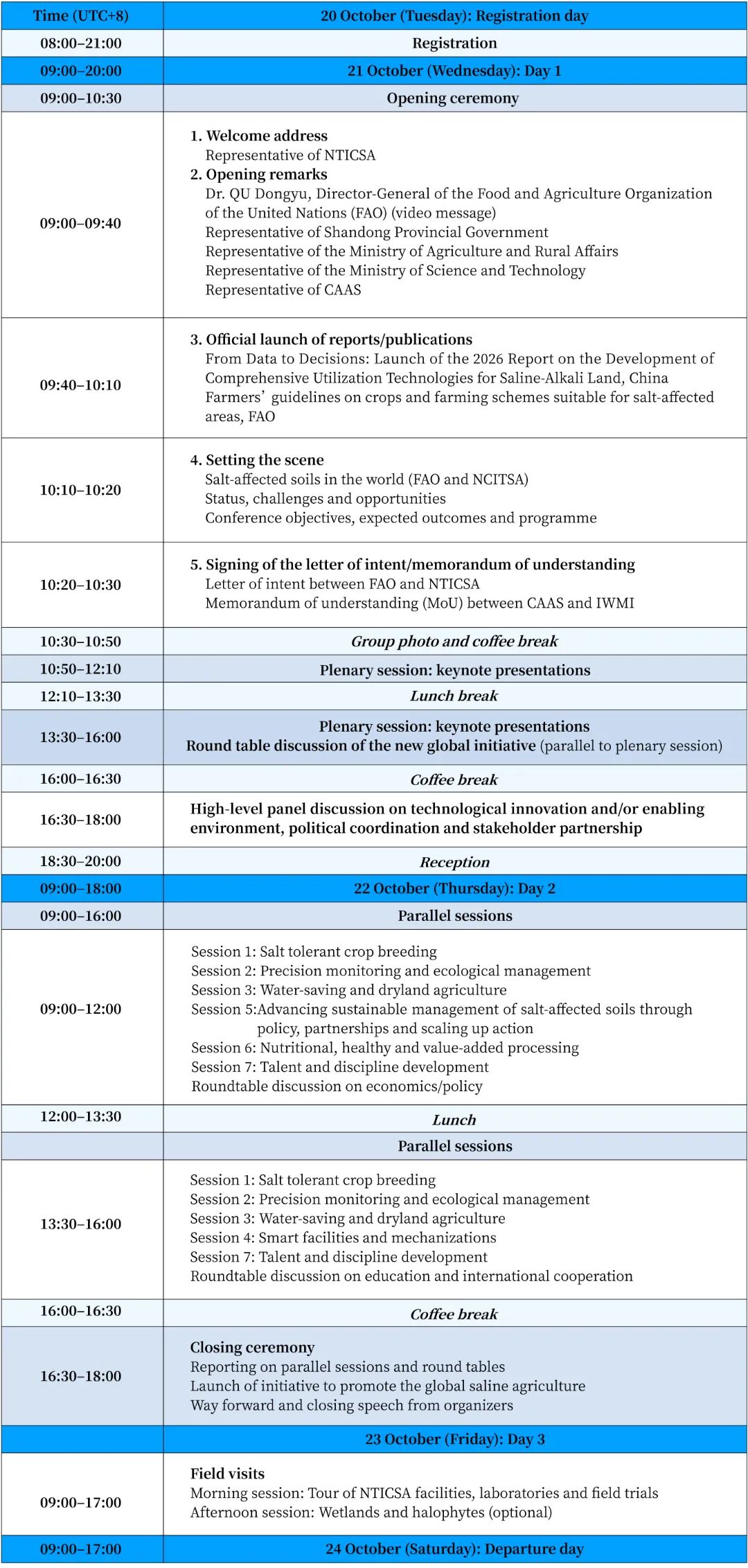
Tentative AGENDA
(subject to ongoing updates)
编辑:耿磊
责任编辑:丁国庆